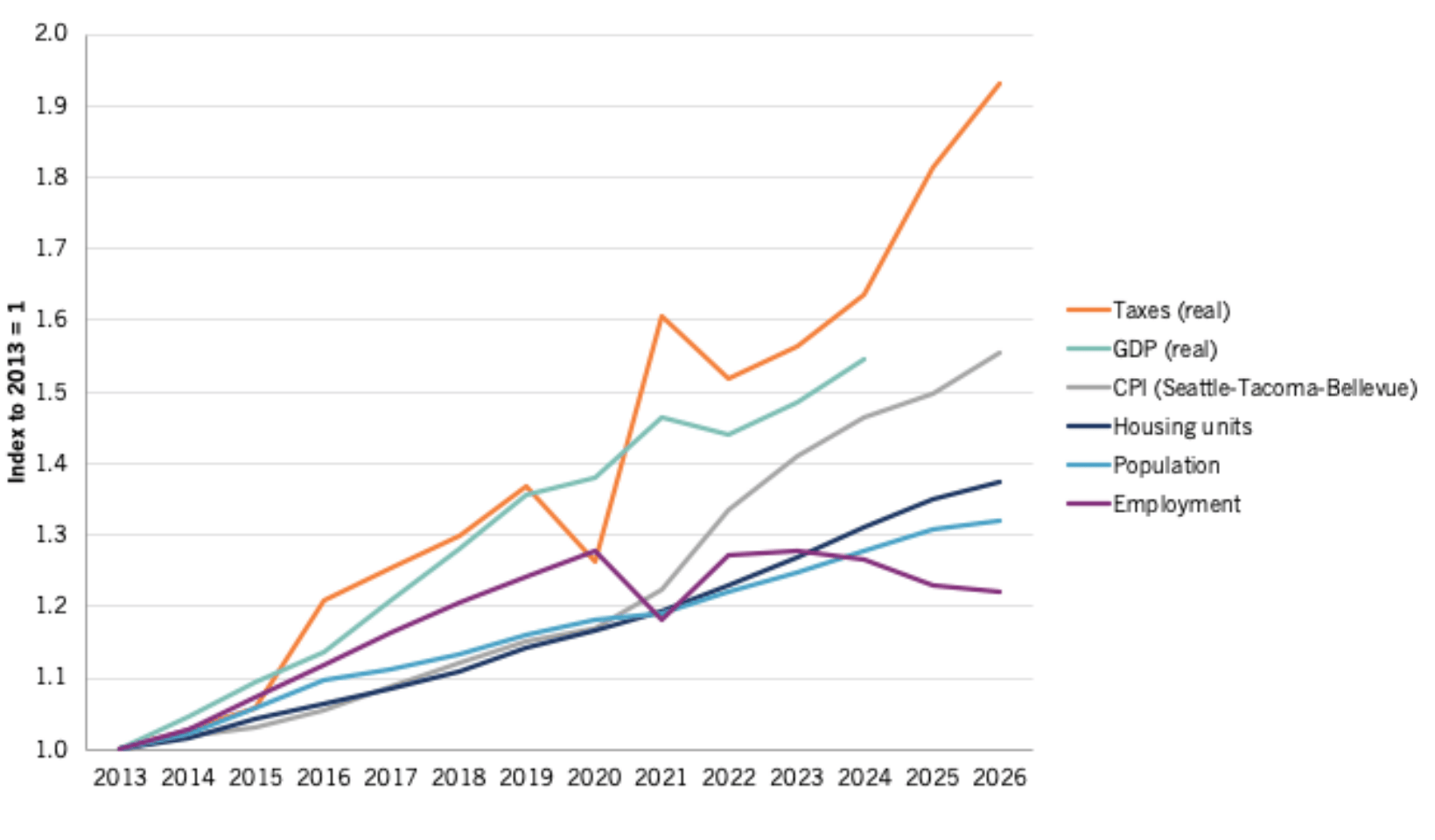
In the ever-evolving landscape of Seattle's economy, a fascinating shift has taken place, as revealed by a recent report. The city's tax burden has dramatically transformed, with businesses now shouldering a significantly larger share of the tax responsibility. This development is particularly intriguing when considering the context of Seattle's post-pandemic recovery and the evolving relationship between the city and its major tech employers.
The Tax Burden's Evolution
Over the past decade, Seattle's tax collections have skyrocketed, reaching an impressive $2.8 billion in 2026. However, the story behind these numbers is more complex. The report, commissioned by influential organizations like the Downtown Seattle Association and the Seattle Metropolitan Chamber of Commerce, highlights a stark contrast between tax growth and other economic indicators. While tax revenues have surged by an astonishing 172%, population growth has lagged at 31%, and job growth has been even more modest at 23%. This disparity raises important questions about the sustainability of such a tax structure.
Targeted Taxes and Their Impact
A key finding of the report is the shift from broad-based taxes, such as property and sales taxes, to more targeted levies. The introduction of taxes like the JumpStart Payroll Expense Tax and the Social Housing Tax has significantly altered the tax landscape. These taxes, paid by a relatively small number of major employers, now account for a substantial portion of the city's business tax revenue. For instance, the top 10 taxpayers for these targeted taxes contribute a significant 73% and 66% of the total bill, respectively. This concentration of tax burden on a few entities is a trend that warrants careful consideration.
Employment Trends and Their Implications
The report also sheds light on the divergent employment trends between Seattle and its neighboring Eastside hubs. While Seattle has experienced a notable job loss, with approximately 24,000 jobs disappearing between 2020 and 2025, the Eastside has seen a gain of 21,000 jobs during the same period. This shift in employment patterns has likely contributed to the increased tax burden on businesses, as fewer jobs mean less tax revenue from traditional sources.
Political Climate and Economic Growth
The political climate in Seattle, often characterized by its stance towards large technology companies, is an essential factor in this narrative. The report's release comes at a time when city leaders and regional business groups are navigating the complexities of post-pandemic work patterns and the evolving relationship with major tech employers. As Joe Nguyen, CEO of the Seattle Metro Chamber, points out, the focus should be on delivering better results with existing resources and creating a tax structure that fosters economic growth.
A Step Towards Sustainability
In response to these economic challenges, Mayor Katie Wilson has proposed a $9.1 billion budget for 2027, which aims to address the general fund deficit and make strategic spending cuts. Notably, the budget includes a freeze on the JumpStart tax rates, suggesting a recognition of the need to ease the tax burden on businesses. This move could be a step towards creating a more sustainable tax structure that supports economic growth and attracts businesses back to Seattle.
Conclusion
The story of Seattle's tax burden shift is a complex interplay of economic, political, and social factors. As we reflect on these developments, it becomes clear that finding a balance between tax revenue and economic growth is crucial for the city's future. The report's findings serve as a timely reminder of the need for thoughtful policy decisions that consider the long-term health of the city's economy and its relationship with its major employers.